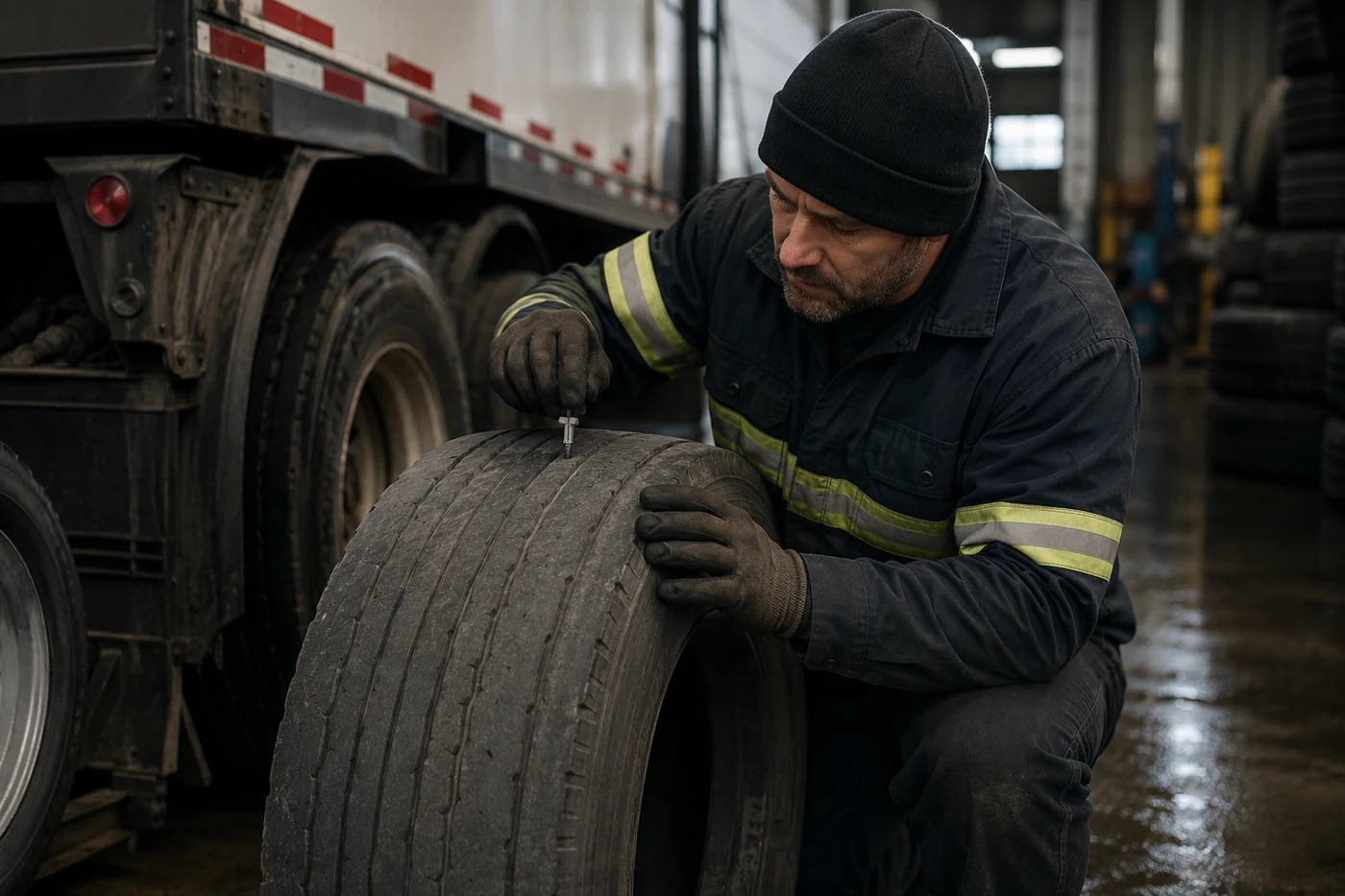
The decision to replace a commercial tire is not always made at the right time — it is often made reactively, after a failure forces the issue, or conservatively late, after the tire has been operating in a compromised state for weeks. Both errors are costly. A blowout on I-84 at highway speed is not just the price of the tire — it is the tow, the roadside service, the missed delivery, and the safety risk to the driver and other vehicles. But replacing a tire prematurely before its mileage life is exhausted wastes value that was already paid for. The goal is accurate replacement timing based on objective criteria, not anxiety or delay.
DOT Tread Depth Minimums: What the Regulations Actually Require by Position
What It IsFederal Motor Carrier Safety Administration regulations under 49 CFR 393.75 establish specific minimum tread depth requirements for commercial vehicles by axle position. Steer axles require a minimum of 4/32 of an inch of tread depth measured in a major tread groove. All other positions — drive axles and trailer axles — require a minimum of 2/32 of an inch. These measurements are taken in the principal grooves of the tread, not at the tire's edge or between tread elements. A tire that meets the minimum at the center groove but is worn below it at the shoulders is still a violation. The measurement should be taken in the major tread grooves, and relying only on the deepest remaining spot can create a misleading picture of tire condition.
What Happens When You Get It WrongRunning a tire at or below the DOT minimum can create two simultaneous problems: a legal compliance exposure during roadside inspection, and a measurable performance deficit that existed well before the legal threshold was reached. Wet braking distance on a steer tire degrades progressively as tread depth decreases — a tire at 3/32 stops measurably longer on wet pavement than the same tire at 6/32, even though only one is below the DOT minimum. For Portland Metro operators running eight months of wet roads, the practical replacement threshold for steer tires should generally be above the legal floor, often around 5/32 depending on route, weather, and operating risk. The legal minimum is a compliance threshold, not a performance recommendation.
What to Do About ItUse a calibrated tread depth gauge — not a penny, not a visual check — during regular inspections or at minimum at every service interval. Record the reading, the date, and the odometer for each tire. When steer tires reach 5/32, schedule replacement. When drive and trailer tires reach 3/32, schedule replacement. Building a one-32nd-inch buffer above the legal minimum into your replacement trigger gives you the lead time to order, schedule delivery, and install without being forced into emergency purchasing at emergency pricing. That buffer costs nothing. The alternative — discovering a violation at a weigh station — costs significantly more.
Reading Irregular Wear Patterns: What Your Tires Are Telling You
What It IsA tire wearing evenly across its full tread width is operating within its design parameters. Tires that wear unevenly are reporting a problem — in alignment, in inflation, in load distribution, or in the vehicle's suspension — that will accelerate wear and reduce mileage life if left uncorrected. The most common irregular wear patterns in commercial tires each indicate a specific cause. Center wear — where the tire wears fastest in the center tread — indicates chronic overinflation. Edge wear — faster wear on one or both shoulders than in the center — indicates chronic underinflation. One-sided shoulder wear — faster wear on one edge than the other — indicates misalignment. Cupping or scalloping — a wavy wear pattern around the circumference — indicates suspension or wheel balance issues.
What Happens When You Get It WrongReplacing a tire that showed irregular wear without correcting the underlying cause means the new tire will develop the same wear pattern, at the same accelerated rate, until it is also replaced prematurely. Operators who cycle through tires faster than expected on a specific axle position often attribute it to tire quality when the real cause is an uncorrected vehicle condition. Misalignment can significantly reduce drive tire life compared to a properly aligned vehicle. At the cost of commercial tires, that difference across a multi-truck fleet over a full year is a meaningful operating cost that a $150 alignment service could have eliminated.
What to Do About ItInspect tread wear patterns — not just depth — at every tire rotation and replacement. Before installing new tires on a position that showed irregular wear, address the underlying cause: check and correct inflation, check alignment, inspect suspension components. A new tire installed on an uncorrected vehicle will produce the same result as the old one. Keep a record of the wear pattern observed when each tire is removed — that record becomes diagnostic data for your fleet's maintenance program and helps you catch recurring problems before they compound across multiple vehicles.
Sidewall Damage: When a Visual Inspection Should Pull a Tire from Service
What It IsThe sidewall is the most structurally critical and most vulnerable part of a commercial tire. Unlike the tread area, which is reinforced with steel belts, the sidewall flexes with every rotation and is exposed to road hazards, curb contact, and debris impacts that the tread does not encounter. DOT regulations and inspection standards can prohibit commercial vehicle operation with tires that show serious sidewall conditions such as: cuts or cracks that expose the ply or belt material; bulges, bumps, or knots that indicate internal damage or separation; fabric breaks or visible cord; or rim damage that prevents proper seating. These are not marginal conditions — any one of them can justify immediate removal from service.
What Happens When You Get It WrongA sidewall bulge is an internal structural failure — a section of the casing where the ply has separated from the belt structure and rubber has ballooned into the void. A bulge should not be treated as a slow-developing condition that can safely be monitored over time. It is a point of structural failure that will ultimately become a sudden, high-speed blowout when the remaining rubber can no longer contain the internal pressure. The timing of that failure is not predictable. A tire with a sidewall bulge that has been "running fine" for a week is not getting better — it is getting closer to catastrophic failure. The only appropriate response is immediate removal from service and replacement.
What to Do About ItWalk every tire during every pre-trip inspection with specific attention to the sidewall — both the outboard side visible during normal inspection and the inboard side between duals, which is where road hazard damage most often goes undetected. The inboard sidewall on a dual drive tire requires a mirror or a deliberate crouch to inspect. Most pre-trip tire checks are done visually from standing height, which means the inboard sidewall of every dual tire on a loaded truck is inspected less thoroughly than the outboard one. Make the effort to check both sides. A tire removed from service for a sidewall bulge costs the price of the tire. A tire that fails at highway speed costs significantly more in every dimension.
Tire Age vs. Mileage: When Time Matters as Much as Tread Depth
What It IsCommercial tire rubber compounds degrade over time through a process called oxidation — even when the tire is not in use. Oxygen exposure, UV light, ozone, and temperature cycling all accelerate the molecular breakdown of the rubber's elasticity. A tire that has been sitting in storage for three years before installation is three years old from an aging perspective, regardless of its tread depth. Many commercial tire manufacturers and safety organizations recommend closer inspection as tires approach six years from the manufacture date — readable from the DOT date code on the sidewall — regardless of remaining tread depth. Ten years is often treated as an absolute maximum by many safety programs, but the correct decision should follow manufacturer guidance, tire condition, and operating application.
What Happens When You Get It WrongAged tires fail in a characteristic pattern: tread separation, where the tread rubber detaches from the casing in sections at highway speed. This failure mode is more common in tires that have been on vehicles that sit for extended periods — trailers in seasonal use, specialized vehicles operated infrequently — because those tires experience significant thermal cycling and UV exposure without the internal heat generation of regular operation that might accelerate visible wear. The result is a tire that looks superficially acceptable — adequate tread depth, no visible sidewall damage — but has a degraded bond between the tread and casing that fails without warning under the centrifugal forces of highway operation.
What to Do About ItCheck the manufacture date — the four-digit DOT date code — on every tire in your fleet, including those on trailers that sit for extended periods. Any tire approaching six years from manufacture should be evaluated closely regardless of tread depth. Any tire older than ten years from manufacture should generally be removed unless specific manufacturer guidance and inspection standards support continued service. When purchasing tires, ask your supplier for the manufacture date on the specific units they are providing. Warehouse-aged stock — tires that have been sitting in distribution inventory for two or more years before reaching you — starts its service life with a meaningful portion of its aging allowance already consumed.
Building a Replacement Schedule Before Failures Force Your Hand
What It IsA proactive tire replacement schedule tracks each tire's installation date, the odometer at installation, the axle position, and the observed tread depth at each inspection interval. With that data, you can project when each tire will reach your replacement threshold — not with perfect precision, but with enough accuracy to plan purchases ahead of need rather than in response to failure. A basic fleet tire log can be maintained in a spreadsheet, a maintenance management system, or even a physical log book. The format matters less than the consistency of recording and the habit of reviewing the data before each replacement cycle.
What Happens When You Get It WrongFleets without tire tracking systems purchase reactively — when a tire fails or when an inspection reveals a near-miss. Reactive purchasing concentrates tire purchases at the worst possible moments: under time pressure, with limited supplier options, at urgency pricing, and often with incomplete specification selection because the priority is getting a tire on the truck, not getting the right tire. Over a year, the cumulative cost difference between reactive and planned purchasing — in tire unit price, in downtime, in labor, and in the occasional wrong tire installed because the right one wasn't available — is measurable in a way that justifies the modest effort of maintaining a tire log.
What to Do About ItStart simple. For each tire currently on your fleet, record the position, the installation date, the current tread depth, and the odometer. Calculate how many miles per 32nd of tread depth the tire has consumed so far, and project forward to your replacement threshold. That projection tells you approximately when each tire will need to be replaced. Build purchase triggers into that schedule — contact your supplier when a tire is projected to reach replacement within 30 days, not when it reaches the threshold. That 30-day lead time is the difference between buying on your schedule and buying on the tire's schedule.
Honest Questions for Your Next Pre-Trip Walk:
If you checked the tread depth on your steer tires right now with a calibrated gauge — not a visual estimate — do you know what number you would find, and is that number one you are confident about?
Are there any tires on your vehicles or trailers that you have not inspected the inboard sidewall on recently — and what is the realistic chance that something has developed there that you have not seen?
Do you know the manufacture date on the oldest tire currently in service on your fleet — and if that tire is approaching six years old, what is your plan for replacing it before age makes the decision for you?