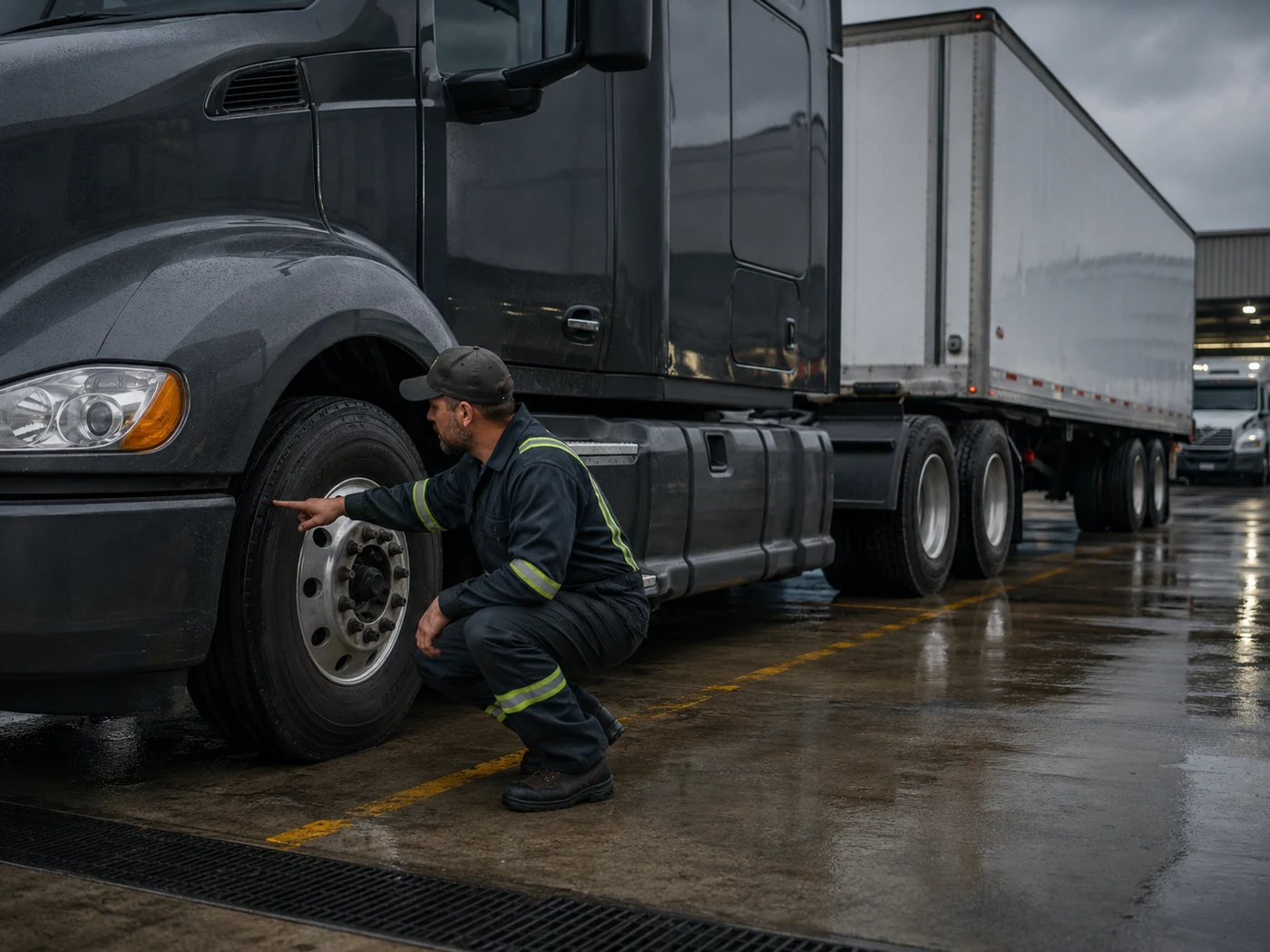
Not all commercial truck tires are the same — and that statement goes well beyond brand or price. Steer tires, drive tires, and trailer tires are engineered from the ground up for fundamentally different jobs. They carry different loads, absorb different forces, wear under different conditions, and are subject to different performance and compliance expectations. Treating them as interchangeable — or letting a supplier sell you the wrong tire for a position because "it's the same size" — is one of the most common and costly mistakes in commercial fleet purchasing.
Why Axle Position Determines Everything About Tire Selection
What It IsEach axle position on a commercial truck subjects a tire to a different combination of forces. The steer axle carries steering input, braking load, and lateral cornering forces — all while supporting the weight of the engine and cab. The drive axles transmit torque from the engine to the road surface and handle a large share of the vehicle's acceleration and braking forces under load. The trailer axles carry static weight over long distances with minimal directional input. These three operating environments require three distinct engineering approaches to tread pattern, compound, ply structure, and load rating.
What Happens When You Get It WrongA tire engineered for one position placed in another will underperform in ways that are not always immediately visible. A drive tire on a steer axle compromises steering response and wet-road handling. A steer tire on a drive axle wears irregularly because its tread pattern is not designed to manage torque. A trailer tire on a drive position may lack the compound durability to handle sustained heat generation from driven rotation. The consequences show up as accelerated wear, handling anomalies, and in the worst cases, structural failures that create serious safety risk.
What to Do About ItBefore any tire purchase, confirm which axle position the tire is intended for and verify that the specification — tread pattern, compound designation, and load rating — is appropriate for that position. Any supplier who does not ask which position you are filling before recommending a tire is not giving you complete service. A steer tire, drive tire, and trailer tire of the same size are not the same product, and they should not be priced, specified, or installed as if they are.
Steer Tires: Precision, Stability, and Why This Position Has the Highest Standards
What It IsThe steer axle is the most safety-critical tire position on a commercial truck. Steer tires are engineered with rib-style tread patterns — continuous circumferential grooves that prioritize straight-line tracking, steering precision, and lateral stability. They carry the highest DOT tread depth requirement of any position: a minimum of 4/32 of an inch, compared to 2/32 for all other positions. Steer tires are also typically built with stiffer sidewalls to resist lateral deflection during cornering and to provide consistent steering feedback to the driver at highway speeds.
What Happens When You Get It WrongA steer tire that is worn below the 4/32 minimum is not just a compliance problem — it can also reduce wet-road stopping performance and handling control. On Portland Metro roads during the eight months of the year when rain is a daily variable, a worn steer tire means longer stopping distances, reduced hydroplaning resistance, and degraded emergency steering response. A DOT roadside inspection finding on a steer tire can produce an out-of-service order, meaning the truck may not move until the issue is corrected.
What to Do About ItReplace steer tires proactively before they reach the 4/32 threshold, and track tread depth during inspections. When purchasing, confirm that the tire carries a steer-position designation from the manufacturer and that the load index matches your actual front axle weight, not just your truck class. The steer position is not where to apply budget tire logic. It is the position where engineering quality, compound integrity, and correct load matching matter most.
Drive Tires: Traction, Torque, and Managing the Demands of a Driven Axle
What It IsDrive tires are built for traction — transferring engine torque to the road surface during acceleration, resisting spin on wet or slippery surfaces, and managing the heat generated by driven rotation at highway speeds. Their tread patterns use deep lug designs with wide lateral grooves that dig into the road surface under torque load. Drive tires are built with reinforced internal structures to resist the lateral forces generated during cornering under load and to withstand the heat generated by sustained highway operation. They also carry load ratings appropriate for the heavier weight distribution of the rear tandem axle.
What Happens When You Get It WrongA drive tire with insufficient tread depth or a compromised lug pattern loses traction under acceleration — which on a rain-wet I-5 on-ramp or a gravel yard surface means wheel spin, loss of control, and potential jackknife risk under braking. Drive tires also experience faster wear than steer tires when overloaded or under-inflated because the torque loading accelerates compound degradation. Irregular wear patterns — heel-and-toe wear, cupping, one-sided shoulder wear — in the drive position are typically the first visible signal that something is wrong with inflation, alignment, or load distribution.
What to Do About ItCheck drive tire inflation every morning. Under-inflation is the single largest contributor to premature drive tire wear and heat-related failure. Rotate drive tires cross-axle at regular intervals — often every 25,000 to 30,000 miles depending on your application and tire manufacturer guidance — to equalize wear patterns across the tandem. When purchasing drive tires, confirm the tread pattern designation is appropriate for your primary operating surface: highway lug patterns for predominantly on-road operation, mixed-service patterns for operations involving unpaved surfaces, yards, or construction zones.
Trailer Tires: Load Capacity, Heat Endurance, and the Position Most Operators Underestimate
What It IsTrailer tires often carry a large share of total vehicle weight but receive less operational attention than they should. They do not steer, they do not drive — they simply roll under static load for extended distances. Their engineering reflects this: trailer tires use rib-style tread patterns similar to steer tires, optimized for straight-line rolling efficiency and low rolling resistance. However, they are also built with internal structures specifically designed to handle continuous high load at highway speeds without generating destructive internal heat. Heat endurance is the most important performance characteristic in a trailer tire, not traction.
What Happens When You Get It WrongTrailer tires that are under-inflated generate significantly more internal heat than properly inflated ones — because every rotation of an underinflated tire can flex the sidewall excessively, and that flex converts to heat. On a long haul from Portland to eastern Oregon — four to five hours on I-84 at highway speed under full load — a trailer tire running significantly underinflated builds heat progressively. That heat accumulates inside the casing in ways that are not visible from the outside and often results in sudden sidewall failure or tread separation miles from any exit. The debris left by trailer tire failures on the highway can create a serious safety hazard for following vehicles.
What to Do About ItInflate trailer tires to the manufacturer's recommended cold inflation pressure every time the trailer sits overnight. Do not rely on visual inspection — a trailer tire can lose 20 to 30 PSI and still appear inflated. Use a calibrated gauge. Also confirm that the load rating on your trailer tires matches the actual axle weights your trailer carries at maximum load — not the trailer's GVWR, but the real axle weight distribution when the trailer is fully loaded for your specific freight type. Trailer tire load mismatches are far more common than most operators realize.
Position Mixing: What Happens When Tires End Up Where They Don't Belong
What It IsPosition mixing — installing a tire in an axle position it was not designed for — happens most often through two routes: a supplier who does not distinguish between positions when making recommendations, or an operator who moves tires between positions during rotation without checking the position designation. Both scenarios are more common than the industry acknowledges publicly. The fact that a steer tire and a drive tire can be the same size — say, both 11R22.5 — does not mean they are interchangeable. The size describes the fitment. The position designation describes the engineering.
What Happens When You Get It WrongSteer tires moved to drive positions wear rapidly at the lug edges because rib-pattern tread is not designed to transmit torque. Drive tires moved to steer positions compromise handling precision and raise the braking distance on wet surfaces. Trailer tires run in any driven position are particularly risky — their internal structures are not engineered to withstand the lateral and torque forces of a drive axle, and they can fail structurally well before tread depth becomes a concern. Any tire moved out of its intended position should be inspected by someone who understands the implications before it goes back into service.
What to Do About ItMaintain a tire log for every vehicle in your fleet that records the tire's position designation, the date of installation, and the odometer at installation. When tires are rotated or moved, update the log and verify that the replacement tire carries the correct position designation for the new location. When ordering from a supplier, specify the axle position explicitly — not just the size — and confirm the tire you receive carries the appropriate manufacturer designation. This takes thirty seconds per order and eliminates one of the most preventable sources of premature tire failure and compliance risk in commercial operations.
Worth Considering Before Your Next Order:
Do you know the position designation — steer, drive, or trailer — of every tire currently mounted on your vehicles, and can you confirm that each one is in the position it was engineered for?
When you last ordered commercial tires, did your supplier ask which axle position you were filling before recommending a specific tire — or did they start with size and price?
If you checked the tread depth on your steer tires right now, do you know whether they are above or below the 4/32 DOT minimum — and is that a number you track proactively or discover during an inspection?