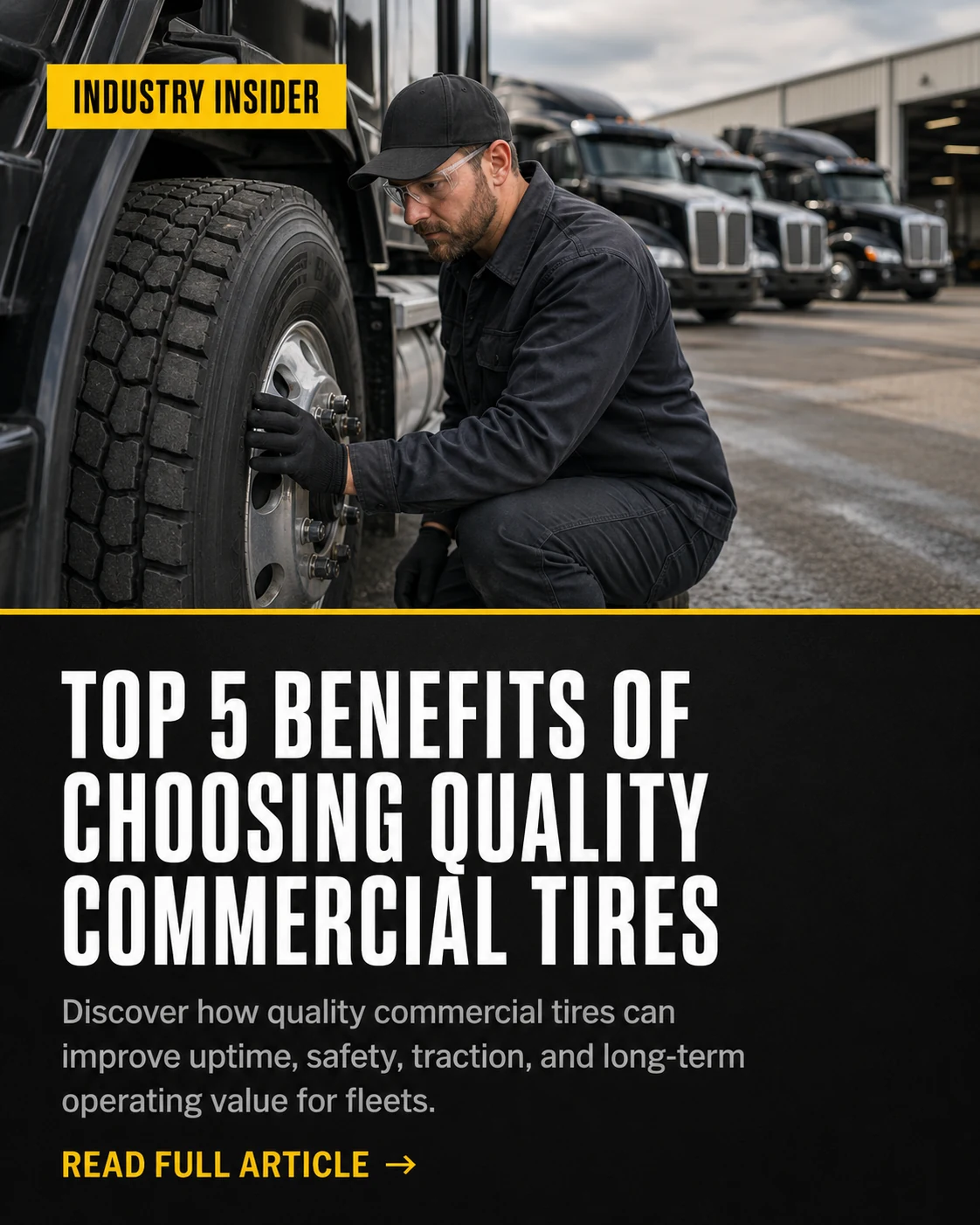
Fleet managers face constant pressure to control costs, and tires are one of the most tempting places to cut. They are purchased repeatedly, they wear out predictably, and the price difference between a quality tire and a cheaper alternative is visible on every invoice. What is less visible — until something goes wrong — is where that difference actually shows up in your operating economics. These are the five areas where tire quality decisions matter most, and what the wrong call costs you in each one.
1. Lower Cost Per Mile Over the Full Replacement Cycle
What It IsCost per mile is calculated by dividing a tire's total purchase price by the number of miles it delivers before reaching legal minimum tread depth. It is the only metric that accurately captures the real economics of a tire purchase — not the sticker price, not the load rating, and not the brand name. A tire that costs more upfront but delivers significantly more miles can produce a lower cost per mile than a cheaper alternative replaced more frequently. This is not theoretical — it is straightforward arithmetic applied to real mileage data from your fleet.
What Happens When You Get It WrongFleets that optimize for purchase price rather than mileage life end up on accelerated replacement cycles without fully accounting for all the associated costs. Beyond the tire invoice itself, frequent replacements mean more labor hours for tire changes, more vehicle downtime during service, and more purchase transactions — each of which carries an administrative and logistical overhead. A fleet running 300,000 miles per year across five trucks may be spending significantly more on tires than necessary simply because the cost-per-mile math was never done on their current choice.
What to Do About ItBegin tracking actual mileage per tire set on your fleet — not the manufacturer's rated mileage, but the real-world miles delivered in your specific application, on your specific routes, at your specific axle loads. Once you have three to five data points per tire spec, calculate your actual cost per mile and compare it against alternatives. That comparison, done honestly, drives better purchasing decisions than any conversation about sticker price ever will.
2. Fewer Roadside Breakdowns and Quantifiable Downtime Reduction
What It IsA commercial tire failure on the road is not just an equipment event — it is a full operational disruption. The direct costs include the tire itself, a roadside service call, and potentially a tow. The indirect costs include the driver's lost time, the missed or delayed delivery, the customer relationship impact, and the administrative overhead of rescheduling and reporting. Properly matched, correctly inflated quality tires can reduce the probability of in-service failure compared to mismatched or lower-build-quality alternatives running the same loads and routes.
What Happens When You Get It WrongFleets that experience recurring roadside tire failures often attribute them to bad luck, road hazards, or driver behavior — when the actual cause is a tire specification mismatch or a quality shortcut made at the point of purchase. A tire running a load rating below the axle's actual weight, or a compound not suited to highway sustained-speed operation, is not a ticking time bomb in the dramatic sense — it is just a tire that will fail sooner and less predictably than one correctly matched to the application. The difference shows up in your roadside service call log over a year.
What to Do About ItTrack your roadside tire events the same way you track fuel costs — by vehicle, by axle position, by tire spec, and by total cost including service and downtime. Even a rough accounting of the full cost per event — tire plus service call plus driver time plus delivery impact — produces a number that changes how you evaluate the price difference between tire options. Most fleet managers who do this calculation discover that the premium for a better-matched tire pays for itself in fewer events alone.
3. Measurable Fuel Economy Improvement
What It IsRolling resistance is the energy a tire consumes simply by rolling under load at highway speed. It is a measurable, documented characteristic of every commercial tire — published in SmartWay certification data and manufacturer spec sheets — and it translates directly into fuel consumption. A tire with lower rolling resistance requires less engine effort to maintain highway speed, which means less fuel burned per mile. For a fleet running high annual mileages, even a modest reduction in rolling resistance per tire computes to meaningful fuel savings across all vehicles over a full year.
What Happens When You Get It WrongBudget tires often carry higher rolling resistance coefficients than their better-engineered counterparts — a trade-off that is invisible on the invoice but visible at the fuel pump over time. A fleet running tires with unnecessarily high rolling resistance is essentially paying a hidden fuel tax on every mile driven. That tax does not appear as a line item on the tire purchase order, which is exactly why it goes unnoticed. It shows up instead as slightly higher fuel costs per truck, spread across the year, attributed to fuel price fluctuations or driver behavior rather than tire selection.
What to Do About ItWhen evaluating commercial tire options, request rolling resistance data alongside price and load specs. For fleets running high annual mileages on consistent interstate routes — the I-5 corridor, I-84, Highway 30 — rolling resistance performance is a legitimate economic variable, not a secondary consideration. Integrate it into your cost-per-mile calculation alongside mileage life and purchase price to get a complete picture of the true cost of each option.
4. DOT Compliance and Inspection Readiness
What It IsCommercial trucks must meet tire condition standards during roadside inspections. Common requirements include at least 4/32 inch tread depth on steer tires and 2/32 inch on other positions, no exposed ply or belt material, no serious sidewall damage, and load ratings appropriate for the axle position. These standards are actively enforced during roadside inspections — and a tire violation can result in an out-of-service order that grounds the vehicle immediately, regardless of where it is or what it is carrying.
What Happens When You Get It WrongCommercial vehicles are inspected at fixed weigh stations, during mobile enforcement operations, and at shipper and receiver facilities with their own compliance requirements. A single out-of-service order from a tire violation costs the price of the tire, the service call to replace it, the driver's waiting time, and the delivery window — and it goes into your safety record. Fleets with patterns of tire-related violations face increased inspection scrutiny, which compounds the operational impact over time. The CSA scoring system means tire violations are not isolated events — they accumulate and affect your carrier profile.
What to Do About ItBuild tire inspection into your pre-trip checklist as a documented practice, not an informal walk-around. Know the specific tread depth requirements for each axle position on each vehicle in your fleet. Ensure that every tire purchased carries confirmed DOT markings, a load index appropriate for the axle position it will occupy, and a speed rating consistent with your operational profile. A supplier who helps confirm these specifications at the point of purchase — rather than leaving every detail to the buyer to verify — is adding real compliance value to the transaction.
5. A Supplier Relationship That Functions Under Pressure
What It IsThe value of a supplier relationship is most visible not during routine purchasing but during operational pressure — a vehicle that needs tires before Monday morning dispatch, a size that needs to be sourced outside normal inventory, a product issue that needs to be resolved without a three-day warranty process. A supplier who can respond quickly, make decisions without escalation, and deliver product reliably in compressed timeframes is an operational asset. One who cannot is a liability that reveals itself exactly when you can least afford it.
What Happens When You Get It WrongFleets that have never been in a time-sensitive tire situation tend to undervalue supplier responsiveness until the first event forces them to test it. A truck grounded Saturday afternoon with a failed tire and a Monday commitment does not need a ticket number — it needs product delivered Sunday or first thing Monday. Suppliers without same-day or next-day delivery capability, without weekend availability, or without local inventory positioned for rapid fulfillment simply cannot serve that situation. The cost of that gap is borne entirely by the operator.
What to Do About ItEstablish your supplier's service capabilities during a normal purchasing transaction, not during a crisis. Ask specifically: what is the cutoff for next-day delivery? What are your weekend hours? What is the minimum order for free delivery to my location? Who do I call if there is a product issue after installation? The quality of those answers — their specificity, their consistency, their operational credibility — tells you whether the supplier relationship will hold up when it actually needs to.
Honest Questions for Your Next Fleet Review:
Do you know your actual cost per mile for the tires currently running on your fleet — and if not, what decision are you actually making when you choose a tire based on price?
When you add up the total cost of your last roadside tire failure — the tire, the service call, the driver time, the delayed delivery — does that number change how you think about the price difference between your current tire and a better-matched alternative?
If a DOT inspector stopped one of your trucks tomorrow and checked every tire for tread depth, load rating compliance, and condition — are you confident about what they would find?