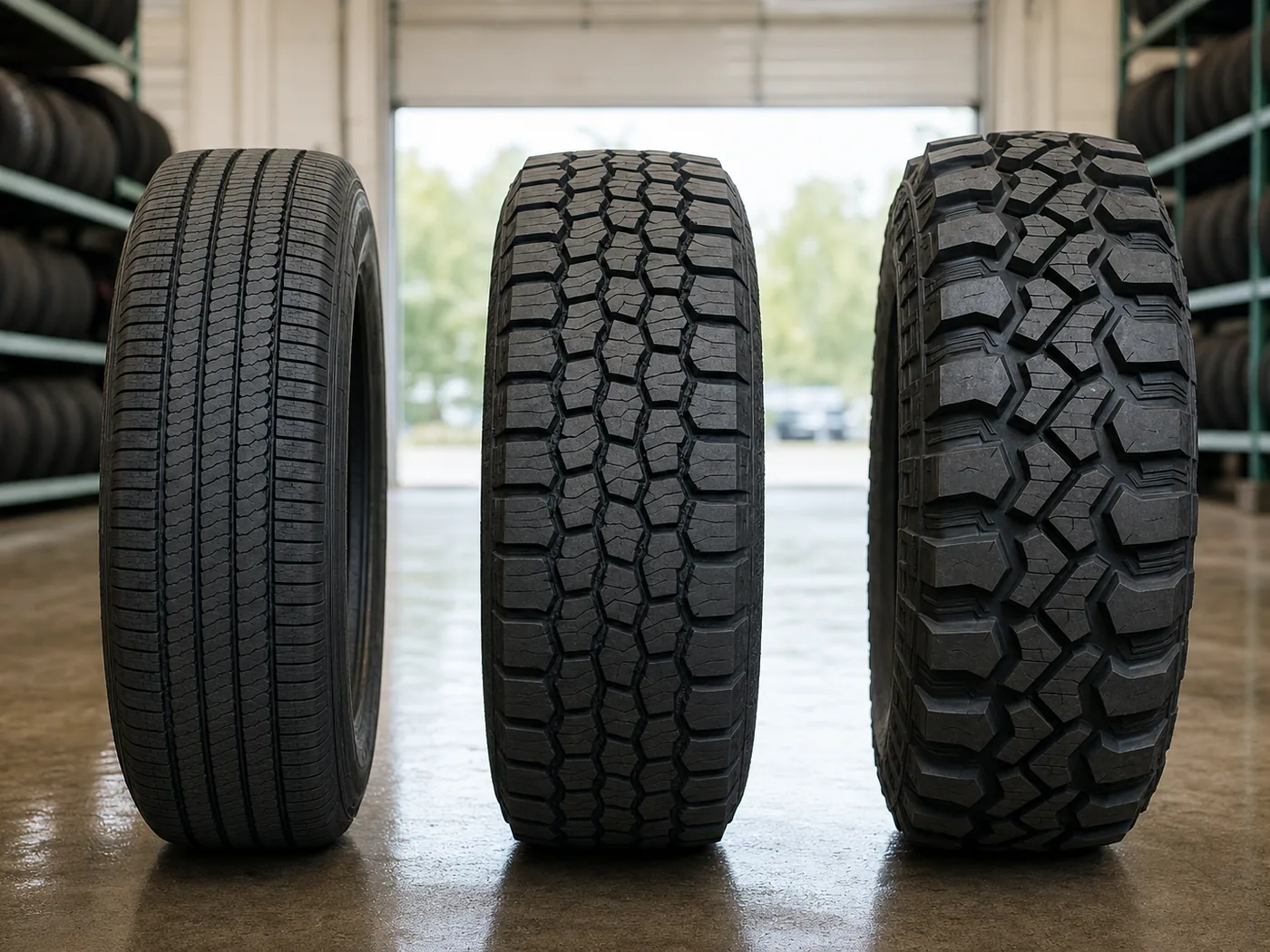
Once size and load range are settled, one decision shapes every mile you drive more than any other: tread category. Highway, all-terrain, or mud-terrain is not a style choice — it is a trade between wear life, noise, wet grip, and off-pavement traction, and the right answer depends entirely on where the truck earns its living. Here is the honest version of that trade, written for trucks that work in the Pacific Northwest.
Highway (H/T): The Working Default
Highway tread — tight rib patterns, heavy siping, quiet-tuned blocks — is engineered for pavement, and most working pickups spend far more time on pavement than their owners like to admit. H/T tires deliver the longest tread life of the three categories, the quietest ride, the best fuel economy, and critically for this region, the most consistent wet-pavement braking. For fleet pickups, delivery routes, and trucks that tow on highways, H/T is not the boring choice — it is the correct one.
All-Terrain (A/T): The Honest Compromise
All-terrain tread splits the difference: larger, more open blocks for grip on gravel, dirt, and job-site mud, with enough siping and pattern discipline to remain civilized on the road. The cost is measurable — somewhat faster wear, more noise, and slightly longer wet-braking distances than a comparable H/T. The benefit is a truck that can leave the pavement without drama. Many modern A/T designs carry the three-peak mountain snowflake (3PMSF) symbol, a genuine severe-snow certification that matters if your work takes you over the passes in winter. For trucks that split time between pavement and unfinished ground — contractors, utility crews, rural routes — A/T is usually the right call. You can see the all-terrain options we quote on our pickup tires page.
Mud-Terrain (M/T): Capability With a Bill Attached
Mud-terrain tread — huge lugs, wide voids, aggressive shoulders — is built to claw through soft ground, and it does that brilliantly. Everything else is the bill: M/T tires are loud, wear noticeably faster, cost more per mile, and their open patterns give up wet-pavement grip precisely where a Portland winter demands it. That trade is worth making for trucks that genuinely work off-pavement — logging access, undeveloped sites, recovery work. It is a poor trade for a truck that sees mud twice a year. If that is your reality, a capable A/T covers the occasional need at a fraction of the running cost. Our mud-terrain section lists what we commonly source.
The Pacific Northwest Factor
Tire marketing is written for the Southwest; Portland trucks live somewhere wetter. In this region, wet-pavement performance is not one factor among many — it is the dominant one, eight months of the year. That pushes the calculus toward heavily siped tread in every category, rewards H/T and road-biased A/T designs, and penalizes open-lug patterns. If winter passes are part of your work, prioritize the 3PMSF symbol over appearance. A tire that looks aggressive and a tire that stops short in the rain are frequently not the same tire.
Matching Tread to How the Truck Works
A simple honesty test outperforms any marketing: describe the truck's ten most typical workdays. Pavement commuting, highway towing, paved delivery routes — H/T. Job sites, gravel, forest roads mixed with daily pavement — A/T, with 3PMSF if the passes are involved. Sustained soft-ground work where getting stuck costs money — M/T, accepted with its costs. The tread that matches the actual workdays, not the aspirational ones, is the tread that will cost you least and grip when it matters. The same logic applies to construction choice, which we cover in LT versus P-metric and load range E explained.
Cost Over the Life of the Tire
Purchase price misleads; cost per mile clarifies. An H/T that runs 60,000 miles, an A/T that runs 45,000, and an M/T that runs 30,000 can carry similar sticker prices while differing by half in what they actually cost to run — before fuel economy differences are counted. Fleets learned this arithmetic long ago; it applies just as strictly to a single work truck.
Worth Considering Before Your Next Order:
Of your truck's last twenty workdays, how many genuinely left the pavement — and does your current tread category match that number or contradict it?
If your routes cross the Cascades between November and March, do your tires carry the 3PMSF severe-snow symbol, or only an aggressive appearance?
Have you ever calculated what your current tires cost per mile of tread life — and how that number would change one category up or down?