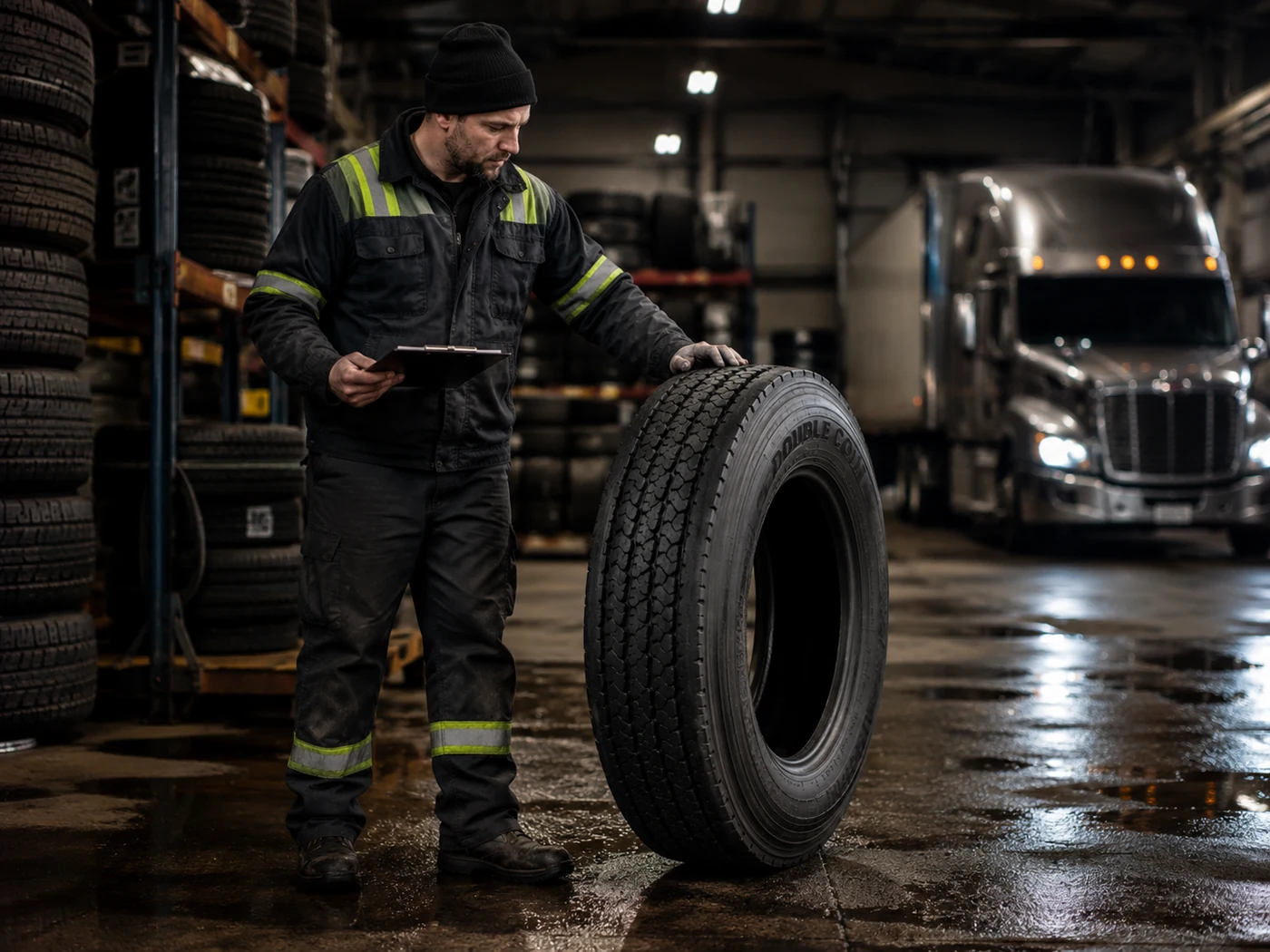
Double Coin is a name that comes up frequently in commercial tire conversations around Portland, but its background and product positioning are rarely explained clearly to the operators buying them. Most buyers know it as "the Chinese tire" or "the cheaper alternative" — descriptions that are technically accurate but operationally incomplete. Understanding what Double Coin actually is, where it fits in the commercial tire market, and what it delivers for specific applications helps operators make genuinely informed purchasing decisions rather than brand-assumption-driven ones.
Who Makes Double Coin Tires and Why the Manufacturer Matters
What It IsDouble Coin is a brand associated with Shanghai Huayi Group Corporation, a large global tire manufacturer. The company has a long history in commercial tire production and sells commercial tires in markets across North America, Europe, and Asia-Pacific. Double Coin tires sold for U.S. highway use should carry DOT compliance markings and are available through established distribution channels. The brand should not be evaluated as a generic, unverified import; it is a commercial tire line sold through established distribution channels and should be judged by its specifications, documentation, and application fit.
What Happens When You Get It WrongOperators who dismiss Double Coin purely on the basis of national origin without evaluating the actual product specifications miss a value opportunity that many North American commercial operators have already considered. Conversely, operators who assume that any tire with the Double Coin name is automatically appropriate for their application without verifying load index, speed rating, and position designation are making the same mistake in the opposite direction. Brand recognition — positive or negative — is not a substitute for reading the specification and matching it to your operational requirements. The name tells you who made it. The sidewall markings tell you what it can do.
What to Do About ItEvaluate Double Coin tires the same way you would evaluate any commercial tire: confirm the load index for your axle load, confirm the speed rating for your operating speed, confirm the position designation matches the axle you are filling, and compare the cost per mile against alternatives at the same specification level. If those numbers work for your application, the manufacturer's nationality is not a relevant variable. If they do not, no amount of brand recognition in either direction changes the math.
Where Double Coin Sits in the Commercial Tire Market
What It IsThe commercial tire market broadly divides into three tiers. The premium tier — Michelin, Bridgestone, Goodyear — commands the highest prices and the strongest brand recognition among both operators and fleet managers. These manufacturers invest heavily in compound research, retreadability engineering, and fuel efficiency optimization, and their prices reflect those investments. The mid-tier global segment — which includes Double Coin, along with brands like Hankook commercial, Sailun, and others — offers tires engineered to meet commercial performance standards at a meaningfully lower price point, often without the same level of brand recognition, retreadability emphasis, or rolling-resistance optimization found in the premium tier. The budget import segment offers the lowest upfront cost but often carries greater uncertainty around mileage life, casing quality, and long-term performance.
What Happens When You Get It WrongOperators who choose Double Coin expecting premium-tier mileage life and retreadability will sometimes be disappointed — because those are not the design priorities that define the brand's value proposition. Operators who choose Double Coin expecting budget-tier failure rates will be pleasantly surprised, because that is also not what the product delivers. The mistake in both directions is applying the wrong expectation set. Double Coin is a mid-tier commercial product positioned for operators who want DOT-marked, load-rated, highway-capable commercial tires at a price point that makes fleet economics work without compromising basic operational safety. That is a legitimate market position, and it matches the needs of a significant portion of the Portland Metro commercial fleet.
What to Do About ItMatch your tire choice to your operational model. If you are running a high-mileage long-haul operation that retreads casings and tracks cost per mile across 500,000-mile vehicle lifetimes, the premium tier's retreadability advantage is worth paying for. If you are running a regional delivery or construction-adjacent operation where tires are replaced on mileage rather than retreaded, and where cost control is a genuine operational constraint, the mid-tier value proposition is the more rational choice. Double Coin serves the second model well. Knowing which model describes your operation is the prerequisite to making the right brand decision.
Common Double Coin Sizes and Portland-Area Fleet Applications
What It IsDouble Coin's North American commercial lineup covers the most common Class 8 sizes used in the Portland Metro area: 295/75R22.5, 11R22.5, 11R24.5, 275/80R22.5, and 285/75R24.5, among others. These sizes cover steer, drive, and trailer positions on the majority of commercial truck and trailer configurations operating in the region — from owner-operator semi-trucks to fleet delivery vehicles to construction dump trucks. Position-specific designations within the Double Coin lineup include steer-designated models with rib tread patterns and drive-designated models with lug patterns engineered for torque transmission. Many models are available in both single and dual fitment configurations with appropriate load index ratings.
What Happens When You Get It WrongOperators who order Double Coin tires without specifying position designation may receive a general-purpose model rather than the position-optimized version. As discussed in the steer-versus-drive-versus-trailer context, using the wrong tread pattern in a given position accelerates wear and can compromise handling or traction depending on the mismatch. The fact that a tire is a quality mid-tier product does not override the physics of tread pattern engineering. A Double Coin steer tire performs correctly in the steer position. A Double Coin drive tire performs correctly in the drive position. Mixing those is a mistake regardless of brand.
What to Do About ItWhen ordering Double Coin tires, specify axle position explicitly in addition to size, and confirm the model designation corresponds to a position-appropriate tread pattern. A supplier who stocks Double Coin and understands the product line should be able to distinguish between their steer and drive models without needing to refer the question to a catalog. That distinction is a reasonable minimum competency test for any commercial tire supplier handling this brand.
What Fleet Operators Actually Experience With Double Coin
What It IsOperator feedback on Double Coin tires in commercial applications often reflects two themes: acceptable mileage life for the price point, and straightforward DOT compliance without quality surprises. Operators running Double Coin on regional delivery routes — Portland Metro, the I-5 corridor, short-haul construction and industrial applications — may report replacement intervals that are shorter than premium brands but produce a lower cost per mile when purchase price is factored in. Operators running Double Coin on sustained long-haul routes — four-plus hour highway stretches at maximum load — report more variable results, with heat management being the most common differentiating factor between successful and unsuccessful applications.
What Happens When You Get It WrongThe operators who report negative Double Coin experiences often share a common pattern: they were running the tires in applications that exceeded the product's design envelope. Long-haul maximum-load sustained highway operation at the edge of the tire's speed rating, in combination with inflation management practices that are marginal rather than consistent, creates conditions where any mid-tier tire will underperform relative to a premium alternative. The product is not failing — the application is exceeding its appropriate range. Recognizing this distinction matters for evaluating whether operator feedback on any brand reflects the product or the use case.
What to Do About ItBe honest about your actual use case when evaluating Double Coin — or any commercial tire brand. Regional delivery, short-haul construction, yard and terminal applications, and moderate-distance highway routes are applications where Double Coin's value proposition may fit well when the tire is correctly matched to the vehicle and load. Sustained max-load long-haul operation, mountain corridor routes, and applications where retreadability is part of the tire lifecycle economics are contexts where the premium tier's additional investment is more easily justified by the return. Know which category describes your operation before committing to a brand decision.
How to Evaluate Whether Double Coin Is Right for Your Fleet
What It IsEvaluating any commercial tire brand for fleet adoption involves comparing four variables against your operational requirements: load index adequacy for your axle weights, speed rating adequacy for your operating speed, mileage life projection relative to your routes and duty cycle, and purchase price relative to the alternative. These four variables produce a cost-per-mile comparison that is more useful than any brand ranking or online review. Double Coin's performance on variables one, two, and four can be strong for the applications described above when the tire is correctly specified. Variable three — mileage life — is where application match matters most and where honest operational self-assessment determines the outcome.
What Happens When You Get It WrongFleet managers who adopt Double Coin across their entire fleet without piloting it in their specific application sometimes discover that the cost-per-mile math does not work out as expected — not because the tire is poor quality, but because their duty cycle falls outside the sweet spot of the product's design. A structured pilot — two to four tires in one position on one vehicle, tracked against your existing product over one full replacement cycle — produces actual data rather than assumptions, and that data is worth far more than any brand recommendation from a supplier with an inventory position to defend.
What to Do About ItIf you are considering Double Coin for the first time, request a small pilot quantity from your supplier, track actual mileage to replacement on a specific route and vehicle, and calculate the resulting cost per mile before committing to fleet-wide adoption. A supplier who supports that process — provides pilot quantities, follows up on performance data, and adjusts recommendations based on what you actually experience — is a supplier who is genuinely invested in your operation's outcome. One who pushes for full fleet commitment without pilot validation may be optimizing for their sales volume rather than your operational success.
Questions to Sit With:
Have you ever compared the actual cost per mile on your current commercial tires — not the price per tire, but the miles delivered per dollar — against what a mid-tier alternative would produce on your specific routes?
If you piloted two to four tires from a different brand on one vehicle for one replacement cycle, what would that data actually tell you — and is there a reason you have not done that comparison yet?
Does your current tire supplier know enough about your operation to tell you which of their products fits your duty cycle and which ones do not — or do they recommend based on what they have in stock?