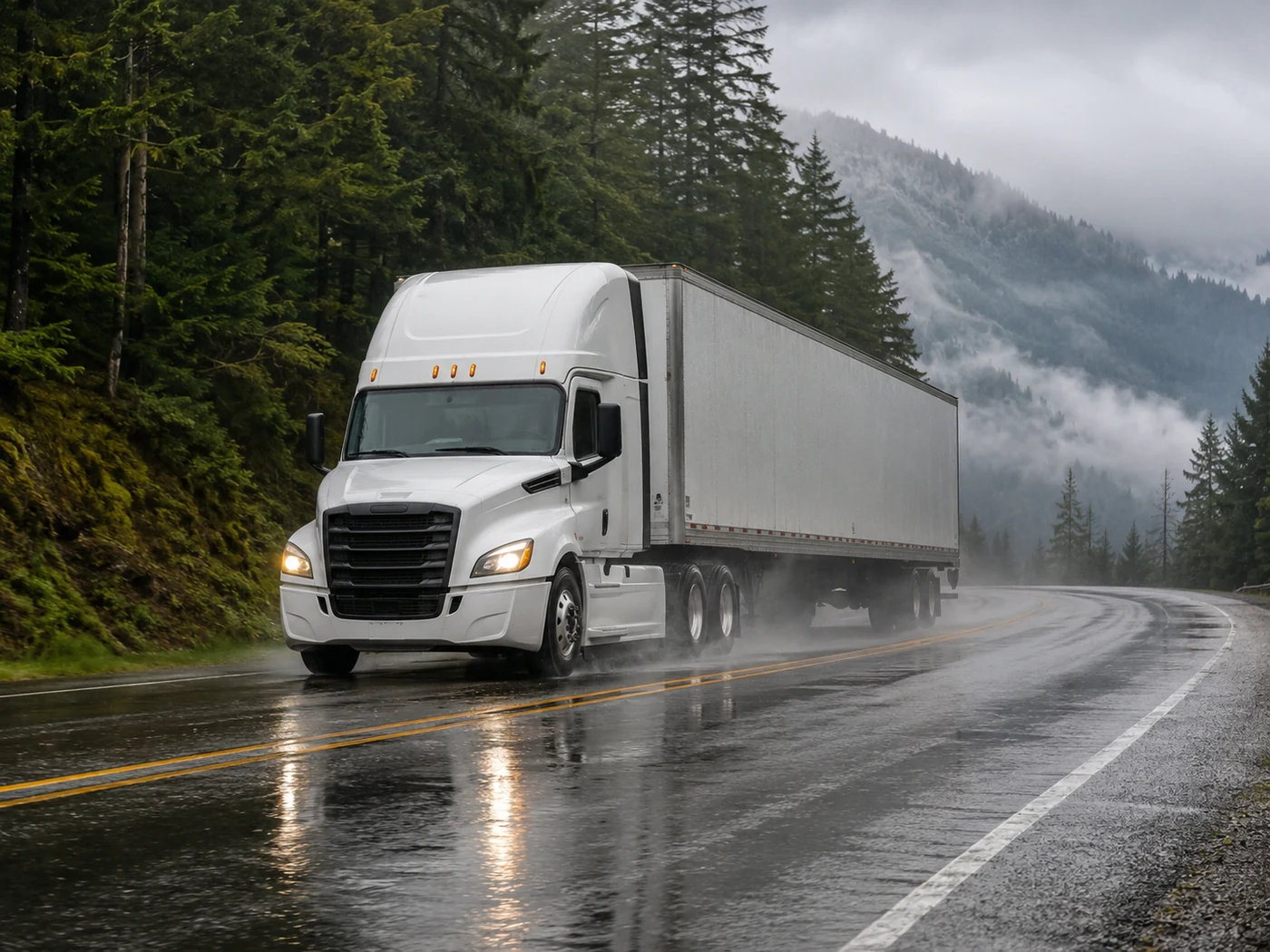
Trucking in the Pacific Northwest is not the same operational environment as trucking in the Southwest or the Midwest — and tire selection that ignores that difference costs operators in performance, safety, and money. Portland's climate, the I-5 and I-84 corridors, the Cascade passes, and the region's mix of urban, industrial, and rural routes create a specific set of demands on commercial tires. Understanding those demands before making purchasing decisions is the difference between tires that serve your operation and tires that merely fit your wheels.
Portland's Rain Season and What Months of Wet Roads Actually Do
What It IsPortland sees frequent measurable rainfall each year, with the wettest stretch typically concentrated from October through May. During those months, wet-road conditions are not an occasional variable — they are often the baseline operating environment. Commercial tires on Portland Metro routes spend a large share of their service life on wet asphalt, wet concrete, wet painted markings, and rain-slicked bridge decks. The Columbia River crossings, the elevated sections of I-5 and I-205, and the industrial access roads around the Port of Portland are among the more challenging wet-surface environments for commercial vehicles in the region.
What Happens When You Get It WrongTires with worn tread depths, compromised hydroplaning resistance, or tread patterns optimized for dry-condition performance can become more dangerous in sustained wet conditions. Hydroplaning — where a tire rides up on a film of water and loses contact with the road surface — can occur at highway speeds with tread depths that are technically above DOT minimums but below the threshold for effective wet-weather performance. For a loaded commercial truck, partial hydroplaning on a freeway on-ramp or bridge deck can be far harder to recover from than it would be in a passenger vehicle. The physics of a loaded trailer make any loss of traction in a turn or braking event potentially catastrophic.
What to Do About ItReplace steer tires well before they reach the 4/32 minimum — consider 6/32 inch a practical replacement threshold for operators running Portland Metro routes year-round. When evaluating commercial tire options, ask specifically about wet-traction performance and hydroplaning resistance ratings. Tires with wide lateral grooves and siping — fine cuts in the tread blocks that create additional water-channeling edges — perform meaningfully better on wet surfaces than tires optimized purely for dry rolling efficiency. Do not wait for rain season to evaluate your tires. The time to assess wet-weather readiness is in September, before conditions make the deficiency dangerous.
The I-5 and I-84 Corridors: High-Speed, High-Mileage, High-Demand
What It IsThe I-5 corridor between Portland and Seattle and the I-84 corridor east toward the Columbia River Gorge and beyond into eastern Oregon and Idaho are two of the highest-traffic and most commercially significant freight routes in the Pacific Northwest. Commercial vehicles on these routes routinely operate at sustained highway speeds for four to eight hours at a time, under full load, in variable weather. The Columbia River Gorge section of I-84 can be one of the more wind-exposed freight corridors in the region, with crosswind conditions that create lateral load on tires beyond what many drivers experience on more sheltered inland routes.
What Happens When You Get It WrongSustained highway operation at full load is the most demanding thermal environment a commercial tire experiences. A tire running at 65 to 70 mph under maximum load generates internal heat continuously. Tires that are not engineered for sustained high-speed, high-load operation — or that are running below recommended inflation pressure — build heat progressively over the course of a long haul. The failure mode is typically not dramatic or sudden. It is a sidewall that has been weakened over hundreds of miles of thermal cycling that finally separates at a point of maximum stress. On a gorge crossing with strong crosswinds, that failure can create a serious vehicle-control event.
What to Do About ItFor operators running regular I-84 and I-5 hauls, heat endurance and sustained-speed performance should be primary criteria in tire selection — not secondary considerations after price and load rating. Check cold inflation pressure before any long-haul departure, not as a general best practice, but because inflation is the single most important variable in heat management during extended highway operation. Tires rated for sustained high-speed operation carry speed rating designations on the sidewall — confirm that the tires you are running carry an appropriate rating for your typical operating speed.
Mountain Passes: Hood, the Cascades, and Grade-Specific Tire Demands
What It IsCommercial vehicles operating routes that cross the Cascades — whether US-26 over Mount Hood, Highway 20 over Santiam Pass, or I-84 through the Gorge and then south toward US-97 — encounter sustained grades that create a completely different set of demands on tires than flat-corridor highway operation. Descending a 6% grade under full load generates sustained braking heat in the drive and trailer tires. Ascending the same grade under engine load strains the drive tires' traction and heat management simultaneously. Oregon Department of Transportation chain control requirements apply to commercial vehicles on several Cascade passes whenever conditions warrant — typically multiple times per winter season.
What Happens When You Get It WrongDrive tires with worn tread patterns lose traction on wet or lightly snowed mountain grades before conditions reach the threshold for chain requirements. A loaded truck that loses drive traction on a mountain grade faces the prospect of stopping in a dangerous location, requiring chain installation under adverse conditions, or, in the worst case, losing controlled forward movement. Trailer tires on mountain descents absorb sustained braking heat that accelerates tread compound degradation and increases the probability of heat-related failure on the descent or in the valley below. These are realistic risks for Pacific Northwest operators, especially when tire condition is already near replacement thresholds.
What to Do About ItOperators whose routes regularly cross Cascade passes should carry chains even during months when chain requirements are not currently active. More importantly, do not enter a mountain route with tires at or near replacement thresholds. A steer tire at 5/32 on a flat Portland route has an adequate safety margin. That same tire on a wet descent of US-26 on a March afternoon does not. Evaluate your tire condition relative to your route profile — not just against absolute DOT minimums.
Wet Traction Compounds vs. Standard Highway Compounds
What It IsCommercial tire manufacturers differentiate their product lines in part by compound formulation — the specific blend of rubber, silica, carbon black, and chemical agents that determines how the tire behaves in different temperature and surface conditions. Many wet-traction compounds use silica and other formulation choices to help the tire conform to micro-texture on wet road surfaces and maintain grip at lower temperatures. Some standard highway compounds prioritize rolling resistance and wear resistance over maximum wet traction. The performance difference between compound types is most pronounced below 45 degrees Fahrenheit — which describes the majority of Pacific Northwest winter driving conditions.
What Happens When You Get It WrongA tire with a dry-optimized compound running on wet Portland roads in November may perform worse in wet-braking distance and cornering grip than one formulated for wet conditions. This difference is rarely visible during routine operation — it surfaces in emergency braking events, in tight cornering on wet exit ramps, and in situations where a driver needs maximum available traction on short notice. The operator who chose the cheaper, dry-optimized tire never sees the difference in normal conditions. They see it once, in a situation where it matters most.
What to Do About ItAsk your tire supplier specifically which compound designation their recommended tire uses, and whether that compound is formulated for all-season or predominantly warm-dry performance. This is a question that knowledgeable commercial tire suppliers can answer from the manufacturer's published specifications. If the answer is vague or redirected to price and size, you are talking to a supplier who is not equipped to help you make this distinction. For Portland Metro operators, all-season compound performance is not merely a luxury specification — it is a practical requirement for eight months of the year.
Route-Specific Tire Selection: Urban Industrial vs. Long-Haul Highway
What It IsNot all Portland Metro commercial routes have the same tire demands. A truck making ten urban delivery stops per day in Northeast Portland, crossing rail crossings, navigating tight industrial access roads, and operating at speeds rarely exceeding 45 mph, stresses tires very differently than a long-haul truck running four hours nonstop on I-5 at 65 mph. Urban delivery cycles generate more steering wear, more curb and pothole impacts, more low-speed traction demands, and more frequent braking events. Long-haul routes generate more heat, more sustained rolling stress, and more hydroplaning exposure at speed. The optimal tire for each application reflects these differences.
What Happens When You Get It WrongA long-haul optimized tire with a hard compound and low rolling resistance performs poorly in urban delivery cycles because its compound does not flex well at the lower temperatures and slower speeds of urban operation — leading to irregular wear and reduced grip in tight maneuvers. A softer, urban-optimized tire in a long-haul application wears faster than expected because its compound was not designed to manage the heat of sustained highway speeds. Matching the wrong tire to a route does not always produce an obvious failure — it produces a tire that underperforms quietly, wearing faster than expected and never delivering the mileage the compound was theoretically capable of.
What to Do About ItDescribe your actual route profile to your supplier before any purchase — not just your tire size and axle position, but the nature of your typical operating cycle. Urban stop-and-go versus sustained highway, loaded weight range, typical speed profile, and the surface conditions you encounter most frequently. A supplier who uses that information to differentiate their recommendation is adding genuine value. One who ignores it and quotes based on size alone is treating you as a transaction rather than an operation with specific needs.
Questions Worth Thinking Through:
Do the tires currently on your steer axle meet your own threshold for wet-road confidence — not the DOT minimum, but the level you would actually want between your truck and a rain-slicked bridge deck at 65 mph?
Has anyone ever asked you about your specific route profile — urban delivery, mountain passes, long-haul corridor — before recommending a commercial tire, or has every supplier started with size and ended with price?
If your routes include mountain passes this winter, are you planning your tire replacement schedule around when conditions become dangerous — or waiting until conditions force the issue?