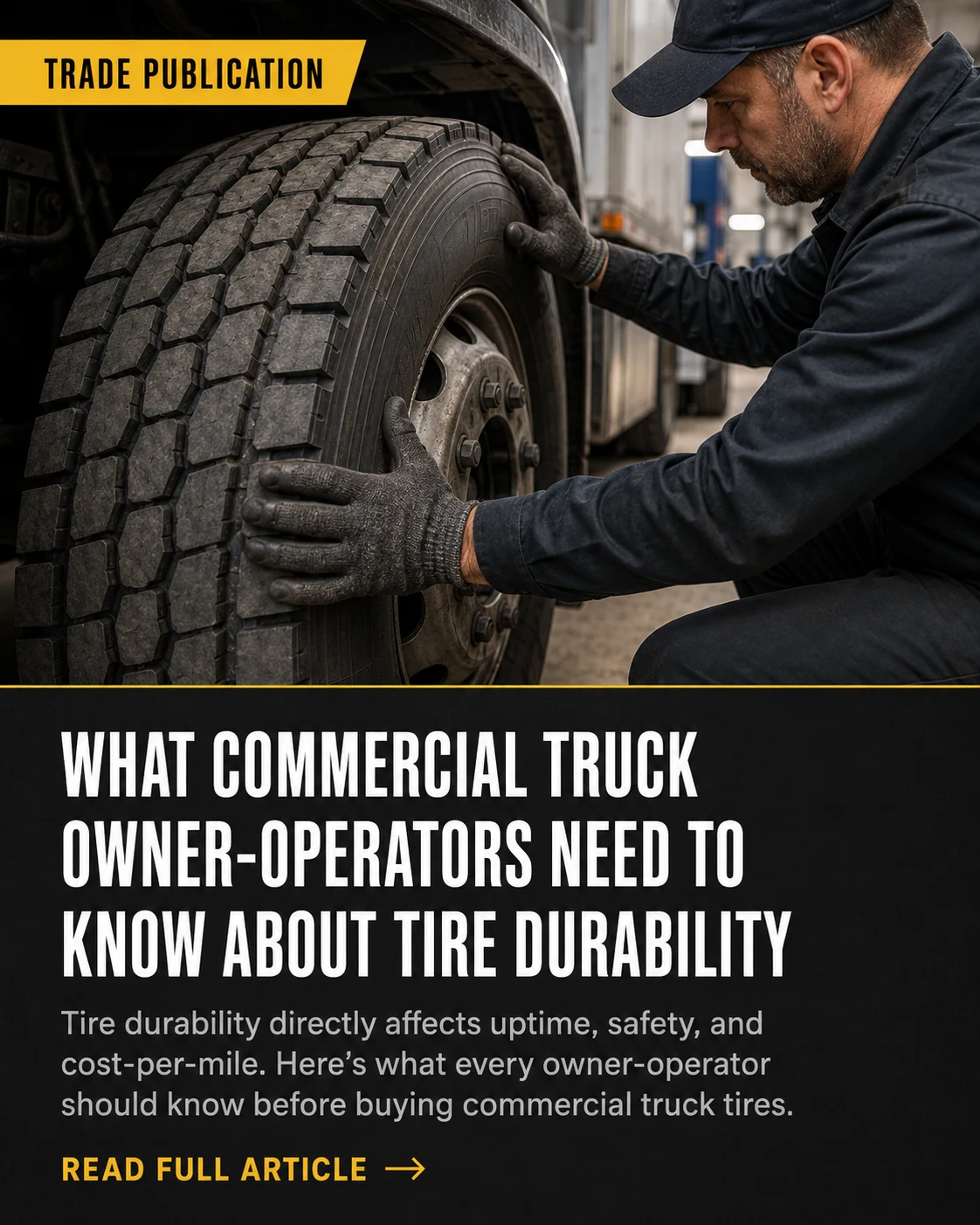
For owner-operators, tires are not just a line item — they are the foundation of your entire operation. A bad tire decision can cost you through blowouts, lost loads, roadside downtime, and violations. A smart one stretches your budget, keeps you rolling, and reduces risk on every run. But durability is not something you can judge by looking at a tire. It is built into compound, construction, and load engineering — and most suppliers never walk you through any of it.
Tread Compound: The Foundation of Long-Term Tire Life
What It IsThe rubber compound used in a commercial tire determines how it handles heat, load stress, and road friction mile after mile. Many high-quality commercial tires use advanced compounds engineered for highway applications — formulated to help manage heat buildup, resist cutting and chipping on rough surfaces, and maintain grip as tread depth decreases. The compound is invisible to the eye but accounts for a significant share of what separates a tire that lasts 100,000 miles from one that needs replacement at 60,000.
What Happens When You Get It WrongBudget tires often cut corners on compound first because it is where cost savings are least visible to the buyer at the point of purchase. A lower-grade compound generates more heat under load, degrades faster under friction, and loses its structural integrity sooner — especially on long-haul routes where sustained highway speeds keep temperatures elevated for hours at a time. The result is premature wear, increased blowout risk, and replacement cycles that arrive far sooner than expected.
What to Do About ItBefore any purchase, ask specifically about the tread compound and the manufacturer's rated mileage life at your expected axle load. A tire rated for longer mileage under your specific load conditions is a fundamentally different product — not just a more expensive one. Run the numbers for your application. In many cases the tire with the better compound costs less per mile even if it costs more per unit.
Load Ratings: The Number That Determines Whether Your Tire Is Safe
What It IsEvery commercial tire carries a load index — a standardized rating that defines the maximum weight the tire can safely support at its rated inflation pressure. For commercial trucks, load ratings are position-specific: steer axles, drive axles, and trailer axles each carry different weight distributions, and the tire in each position needs to be rated accordingly. A load index stamped on the sidewall is not a suggestion — it is a safety and compliance threshold.
What Happens When You Get It WrongRunning a tire with a load rating below your actual axle weight is both a safety risk and a regulatory violation. Under-rated tires flex more under load, build heat faster, and are significantly more likely to experience sidewall failure or blowout. During a DOT roadside inspection, a tire that does not meet the load requirement for its position can trigger an out-of-service order — meaning your truck does not move until it is corrected, regardless of where you are or what is on the trailer.
What to Do About ItConfirm the load rating for every axle position on your specific configuration before purchase. This means knowing your actual axle weights — not just your truck's GVWR — and matching the tire's load index to what that position actually carries. If your supplier is not asking these questions before recommending a tire, that is itself important information about how they operate.
Heat Management: The Silent Cause of Premature Failure
What It IsHeat is the primary enemy of commercial tire longevity. It is generated by three main factors: underinflation, overloading, and sustained high-speed operation. When a tire runs below its recommended pressure, its sidewalls flex more with every rotation — and that flex generates heat inside the casing. Over time, that heat breaks down the rubber compounds, weakens the internal belt structure, and accelerates tread wear unevenly across the contact patch.
What Happens When You Get It WrongA tire running significantly underinflated does not just wear faster — it can experience catastrophic failure with little warning. The internal heat buildup from chronic underinflation weakens the casing in ways that are not visible from the outside. Blowouts attributed to "bad tires" are frequently traced back to sustained underinflation that had been building for days or weeks before the failure. The cost is not just the tire — it is the tow, the service call, the missed delivery, and potentially the load.
What to Do About ItCheck tire pressure every morning before your first run — cold, before the tire has built operational heat. It takes two minutes and is the single highest-return maintenance habit available to an owner-operator. Use a calibrated gauge, not a visual check. Tires can lose significant pressure and still look inflated. Know the recommended cold inflation pressure for each axle position on your specific configuration and write it down somewhere visible in your cab.
Casing Integrity: What Is Inside the Tire Matters as Much as the Tread
What It IsA commercial tire's casing — the internal structure of steel belts, nylon plies, and bead wires — is what gives the tire its shape, load-bearing capacity, and resistance to road hazards. High-quality casings are engineered for multiple retread cycles, meaning the casing remains structurally sound long after the original tread is worn. Casing quality is not visible from the outside and is rarely discussed in budget tire transactions, but it defines how a tire holds up to the daily punishment of commercial use.
What Happens When You Get It WrongA weak casing fails in predictable ways: sidewall bulges, belt separation, and irregular tread wear patterns that no amount of rotation can fix. On rough road surfaces, over railroad crossings, or through construction zones — which are daily realities on Portland Metro routes — a compromised casing absorbs impacts differently than a properly built one. The result is accelerated structural fatigue that ends the tire's useful life long before the tread is worn to legal minimum depth.
What to Do About ItAsk your supplier about casing quality and whether the tire you are buying is designed to be retreadable. A retreadable casing is a signal of structural quality — it means the manufacturer built the internal architecture to last beyond a single tread cycle. For owner-operators running the same routes repeatedly, a quality casing also means more consistent handling and load response mile after mile, which matters for driver comfort and vehicle control.
New vs. Retreads: Understanding the Real Trade-Off
What It IsRetreads are commercial tires where a worn casing has been fitted with new tread rubber through a controlled manufacturing process. When the casing is sound and the retread is done properly, a retreaded tire can perform comparably to a new tire in certain applications — particularly in trailer positions on predictable routes. The cost difference between a retread and a new tire is real and can make retreads an attractive option for fleet economics.
What Happens When You Get It WrongThe risk with retreads is casing history. A retread is only as good as the casing it is built on — and unless you know that casing's full history, you are making assumptions about its structural integrity. For owner-operators running long-haul routes, mountain grades, or high-mileage Pacific Northwest corridors where road surfaces and weather conditions are variable, a casing with unknown history introduces risk that a new tire eliminates entirely. The highway debris sometimes attributed to retreads is typically the result of failed casings, not failed tread.
What to Do About ItMatch the tire type to the application. Retreads have a legitimate place in trailer positions on controlled routes where casing history is known. For steer and drive positions — where failure consequences are most severe — new tires with documented load ratings and compound specifications offer a level of certainty that a retread with unknown history cannot match. Know what you are buying and why, not just what it costs today.
Before Your Next Tire Purchase, Consider:
When you bought your last set of tires, did anyone ask about your axle load at each position — or did they just confirm the tire size and move on to price?
If one of your tires failed on I-84 tonight, would you know right now whether it was running at the correct inflation pressure this morning — and does your current supplier make it easy to get replacement product to your location fast?
How many miles are you actually getting out of your current tires, and do you know if that number reflects the compound and casing quality you paid for — or a gap between what was promised and what was delivered?