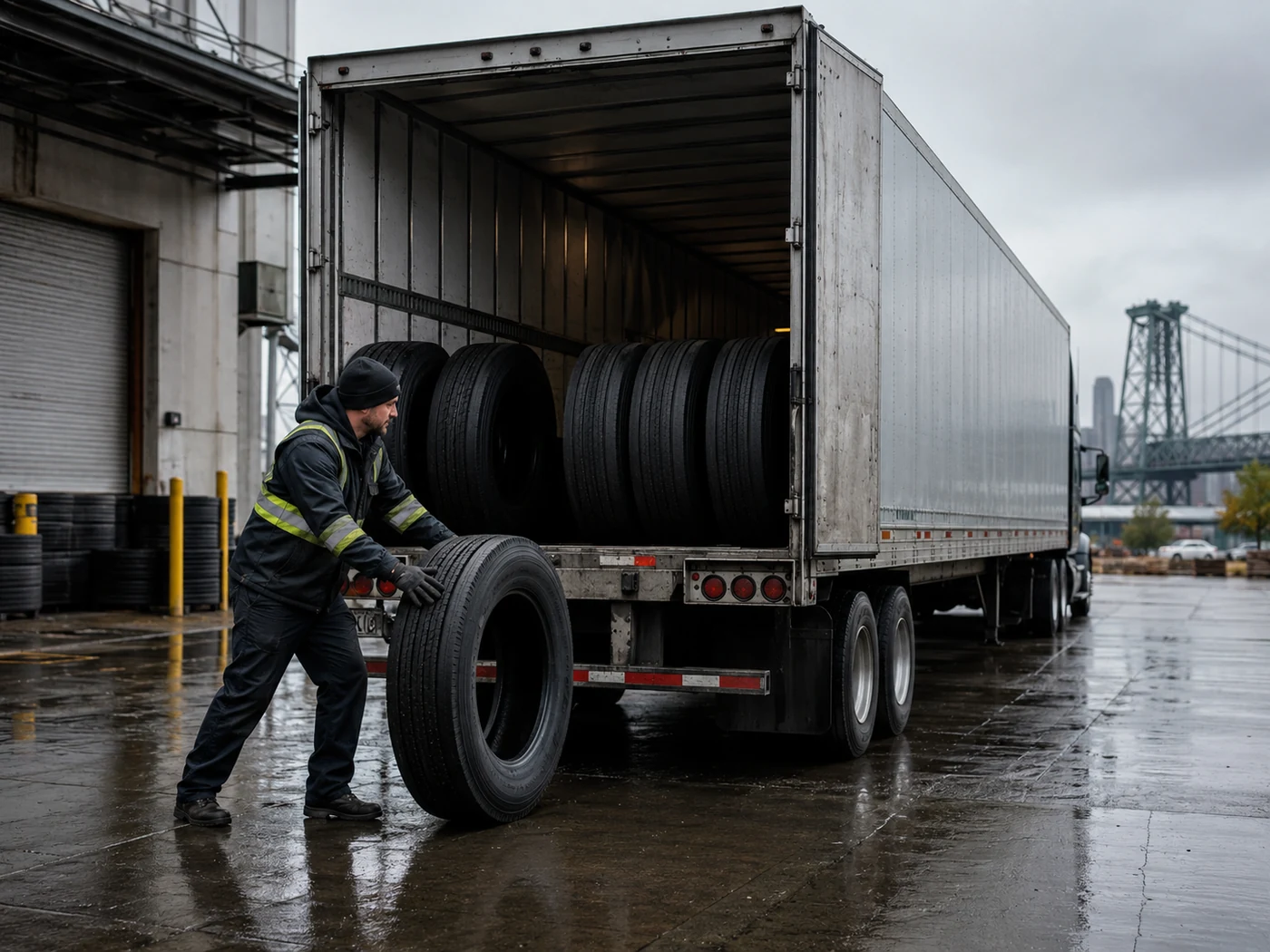
Most commercial tire purchasing decisions focus entirely on the tire itself — brand, size, price, load rating. The delivery logistics get almost no attention until something goes wrong: a wrong delivery window, a missed cutoff, tires that arrive the day after the truck was supposed to roll. For Portland Metro operators, understanding how commercial tire delivery actually works — not how a supplier describes it in a sales conversation, but how it functions operationally — is the difference between a supplier relationship that supports your schedule and one that repeatedly creates exceptions to it.
Inventory may be stored at Oregon or Washington warehouse locations, so customer pickup and delivery should be prearranged. Call ahead and we will confirm the correct pickup location, availability, and timing before tires are released.
Why Delivery Speed Is Part of Your Total Tire Cost Calculation
What It IsCommercial tire delivery speed is an economic variable, not just a convenience factor. Every hour a commercial vehicle sits idle waiting for tires is an hour it is not generating revenue. For an owner-operator running a committed lane or a fleet operator with scheduled dispatch commitments, a tire that cannot arrive until Tuesday when the truck needs to roll Monday morning has a real cost that does not appear on the tire invoice but absolutely appears in the operational budget. That cost — driver time, lost load, rebooking fees, customer relationship impact — can exceed the per-tire price difference between a faster supplier and a slower one.
What Happens When You Get It WrongOperators who choose tire suppliers based purely on unit price, without evaluating delivery capability, discover the gap during their first time-sensitive event. That event may not happen every month, but most commercial operators eventually face some version of it. A tire that fails Friday afternoon on a truck scheduled for a Saturday morning departure puts the entire weekend's revenue at risk if the supplier cannot deliver Saturday. A supplier whose delivery window is Monday through Friday, business hours only, is a supplier who cannot serve that situation regardless of their pricing. The cost of that one event — measured in lost revenue, emergency sourcing at premium pricing, and the scramble to find an alternative — can exceed months of savings from the better unit price.
What to Do About ItCalculate your actual cost of a one-day tire delay before the event makes the calculation for you. Estimate your daily revenue per truck, the probability of a time-sensitive tire event in any given month, and the cost of emergency sourcing if your primary supplier cannot deliver. That calculation produces a number that should directly inform how much weight you give to delivery capability versus unit pricing when evaluating suppliers. For most commercial operators, the number is large enough to justify paying a modest premium for a supplier with genuinely fast, flexible delivery over one who is cheaper but slower.
Understanding the Portland Metro Delivery Radius and What It Covers
What It IsCommercial tire delivery in the Portland Metro area is not uniformly available across the full bi-state region. Suppliers with Portland-based inventory can often offer next-day or same-day delivery to locations within a defined radius — often 20 to 30 miles from their distribution point — but coverage may become less reliable and lead times may extend for locations at the edges or outside that radius. The Portland Metro commercial zone includes the city proper, Gresham, Lake Oswego, Beaverton, Hillsboro, and the Columbia River industrial corridors, with Oregon and Washington warehouse locations helping support pickup and delivery coverage. Vancouver, WA and Clark County can be within the practical delivery footprint for Portland-based suppliers, but may be subject to different minimum order requirements or slightly longer lead times depending on the supplier's logistics model.
What Happens When You Get It WrongOperators who assume their location falls within a supplier's free delivery zone without confirming it explicitly sometimes discover on their first order that their yard is outside the radius — triggering a delivery fee they were not expecting, or a longer lead time than the supplier's standard marketing language suggested. Industrial areas east of I-205, locations in Clackamas County, and some Clark County addresses may sit near the boundary of delivery zones for Portland-based suppliers. Confirming your specific address's delivery status — not just the general area — is worth doing before you depend on it.
What to Do About ItProvide your specific delivery address — including ZIP code and any access requirements (gate codes, receiving hours, dock requirements) — when establishing a supplier relationship, and confirm in writing where your location falls relative to the delivery radius and any associated minimum order requirements. Do this during a routine order, not during an emergency. Discovering that your yard is outside the free delivery radius at 4 PM on a Friday when you need tires by Monday morning is a situation that could have been avoided with one phone call during a non-urgent moment.
Order Minimums, Lead Times, and Planning Around Them
What It IsCommercial tire suppliers typically structure their delivery economics around order minimums — a threshold number of tires that qualifies for free or subsidized delivery. Order minimums in the Portland Metro market often range from six to ten tires per order for free next-day delivery within the standard radius. Orders below the minimum either incur a delivery fee or require the buyer to arrange pickup. Lead times — the time between order placement and delivery — vary by supplier inventory depth and logistics model. Suppliers with physical inventory in the Portland Metro can often fulfill orders placed by a morning cutoff for next-day delivery. Suppliers who special-order or ship from regional warehouses typically require two to five business days regardless of order size.
What Happens When You Get It WrongOperators who place orders below the minimum quantity threshold without confirming delivery terms are sometimes surprised by fees that were not discussed in the price quote. More commonly, operators who order reactively — when a failure forces the issue — find themselves below the minimum because they only need one or two tires, which means either paying a delivery fee or waiting to consolidate the order with other needs. Planning purchases ahead of need, with quantities that meet or exceed the minimum threshold, eliminates both problems simultaneously and typically results in better unit pricing as well.
What to Do About ItKnow your supplier's minimum order threshold and plan purchases to meet or exceed it when possible. For a fleet running multiple vehicles, this often means consolidating purchases across vehicles that are approaching replacement thresholds rather than replacing one vehicle's tires at a time. A five-truck fleet with two trucks approaching steer tire replacement within the next 30 days can consolidate those purchases into a single order that meets the minimum, qualifies for free delivery, and potentially benefits from volume pricing — versus two separate below-minimum orders that each incur a delivery fee and require scheduling separate delivery windows.
What Information to Have Ready Before You Place an Order
What It IsA commercial tire order placed with complete information is processed faster, fulfilled more accurately, and requires fewer follow-up calls than one placed with partial information that the supplier has to complete through clarifying questions. The information that determines the outcome of a commercial tire order includes: tire size in the full format (section width / aspect ratio R rim diameter), axle position for each tire (steer, drive, or trailer), quantity per position, load index or load range requirement, preferred brand if applicable, and delivery address with access details. For first-time orders with a new supplier, the axle weights for each position are also useful — they allow the supplier to confirm that their recommendation matches your actual load requirements.
What Happens When You Get It WrongIncomplete orders — those placed with only partial specifications — create three predictable problems. First, the supplier fills in the gaps with assumptions that may not match your requirements, resulting in the wrong tire delivered. Second, the clarification process adds time to order fulfillment, potentially missing the cutoff for next-day delivery. Third, incomplete orders create ambiguity about who is responsible when the delivered product does not match expectations — the operator who did not specify clearly, or the supplier who assumed incorrectly. All three outcomes are avoidable by providing complete information at the point of order placement.
What to Do About ItBefore calling or messaging your supplier with a tire order, write down the full specification for every tire you are ordering: size, position, quantity, any brand or compound preferences, and the delivery address. That list takes two minutes to compile and eliminates the most common sources of order errors and fulfillment delays. For recurring orders — if you run the same equipment on the same routes — create a standard order template with your specifications pre-filled that you can reference every time. Share that template with your supplier so they have it on file. A supplier who maintains a customer order profile that includes your standard specifications is a supplier who can process your order faster and with fewer errors than one who asks the same questions every time.
Building a Supplier Relationship That Holds Up Under Pressure
What It IsA commercial tire supplier relationship has two modes: routine and emergency. In routine mode, any competent supplier can fulfill an order adequately — the product arrives, the price is acceptable, the logistics work. The relationship's real value becomes apparent only in emergency mode: the weekend tire failure, the time-sensitive departure, the order that needs to be expedited because a vehicle's schedule was accelerated. A supplier relationship built on price alone, without investment in communication history, order familiarity, and mutual understanding of operational requirements, performs well in routine mode and fails in emergency mode. That failure happens at the worst possible moment.
What Happens When You Get It WrongOperators who treat every tire purchase as a transactional commodity — calling whoever has the lowest price on any given order — consistently find themselves without a reliable emergency resource when the situation demands one. A supplier who does not know your equipment, your order history, your delivery address, or your operating schedule cannot prioritize your emergency efficiently, because every order from you is functionally a first order. The time spent re-explaining your requirements during an emergency is time that should be spent processing the shipment. Operators who have built genuine supplier relationships — with a contact who knows their name, their fleet, and their typical needs — get to skip that explanation and go straight to the solution.
What to Do About ItInvest in the supplier relationship during routine orders so it is already built when you need it for an emergency. Provide your full fleet specifications to your primary supplier so they have the information on file. Ask who your primary point of contact is and how to reach them directly — not the main line, but the specific person or number to use when timing is critical. Learn the cutoff times for same-day processing and next-day delivery so you can place emergency orders within the window that makes them possible. A supplier relationship is an operational asset. Like any asset, it produces returns proportional to what was invested in building it.
Questions Worth Answering Before You Need Them Urgently:
If one of your trucks needed tires at 3 PM on a Friday afternoon for a Monday morning departure, do you have a supplier who could deliver Saturday — and have you confirmed that with them directly, not just assumed it from their general availability?
Does your primary tire supplier have your full fleet specifications on file — the sizes, positions, and load requirements for each vehicle — so that a repeat order takes minutes rather than a full discovery conversation?
When you last placed a tire order, did you consolidate purchases across vehicles to meet the delivery minimum — or did you place a below-minimum order and absorb a fee or a longer lead time that a bit of planning could have avoided?